Specialist cops, from the Greater Glasgow Human Trafficking Unit, raided three properties in Denniston, Maryhill and Thornliebank, Glasgow, on Monday.
THREE people have been charged with human trafficking and sexual exploitation offences after a major police probe in Glasgow and Edinburgh.
A search warrant was also executed at an address in Edinburgh’s Canongate.
Two men aged 32 and 45, and a 28-year-old woman were arrested in Glasgow and charged in connection with human trafficking and sexual exploitation.
The trio appeared at Glasgow Sheriff Court today.
A 31-year-old man was also reported to the Procurator Fiscal.
Detective Inspector Mark McLennan of Greater Glasgow CID said: “We worked closely with Edinburgh City, National Human Trafficking Unit and Home Office Immigration Enforcement Crime and Financial Investigation Scotland as part of this operation.”
Marilyn Manson has been accused of sexually trafficking children because the FBI has requested that Mount be investigated. On February 1, 2021, Evan Rachel Wood publicly nominated Marilyn Manson as an abuser and urged many victims to file similar allegations against a 52-year-old child. game of Thrones Actress Esme Bianco is the latest woman to share her story, and she claims that Marilyn Manson trafficked her. Massachusetts officials are now seeking an investigation into multiple accounts of Marilyn Manson’s sexual trafficking minors. The announcement is made while Florida authorities are dealing with Manson’s allegations of sexual assault on minors. Allegations of sexual abuse and trafficking of minors were not filed without investigation, and Esme Bianco has already submitted her statement to the FBI. There are no specific details about the allegations that are publicly available, and we are waiting to see if Marilyn Manson will be prosecuted.
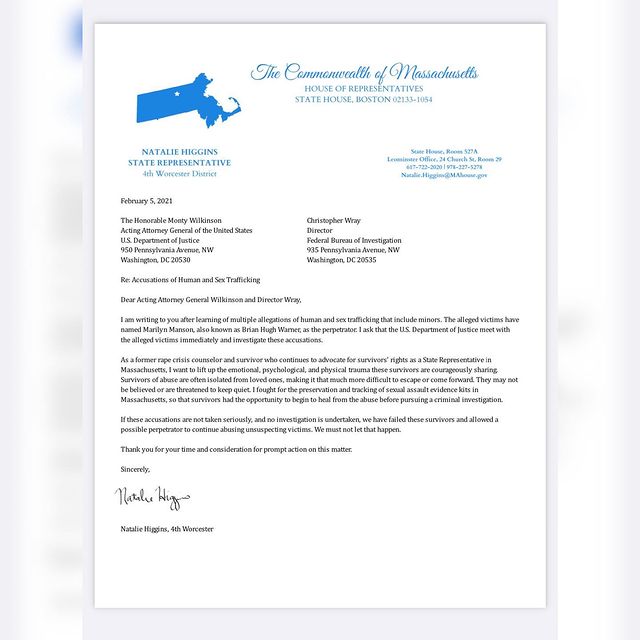
Evan Rachel Wood shared a letter on her official Instagram account, and Massachusetts representative Natalie Higgins called on the FBI and the Department of Justice to investigate allegations of child sexual trafficking against a 52-year-old singer. Details are unknown, but if Marilyn Manson contacted minors, skipped them to attend a concert, and engaged in sexual activity with them, the situation would be appropriate for a child’s sexual trafficking charges.
There is a possibility of becoming. At this point; but there is no public explanation as to why multiple states are seeking Manson’s investigation for sex trafficking minors. In her letter, Congressman Natalie Higgins specifically states that the minor identified and named Brian Hugh Warner, also known as Marilyn Manson, as an abusive person.
You can see Congressman Higgins’ letter to the FBI and the Department of Justice below.
Esme Bianco shared a cool story about Marilyn Manson allegedly flying her to her home in Los Angeles, pretending to shoot a music video that evolved into a three-day torture and BDSM session. According to her statement to the Justice Officer, Manson’s alleged actions constitute trafficking. If Marilyn Manson behaves like a minor, or if he photographs or videos a minor, he may be accused of child pornography.
Marilyn Manson maintains his innocence and says he had an agreed relationship with a woman. He makes no mention of recent allegations of child trafficking in sex.
LONDON (Thomson Reuters Foundation) – Britain should pay 90,000 euros (78,590 pounds) in compensation to two Vietnamese men who were convicted of drug crimes despite signs they had been trafficked as children and forced to work on cannabis farms, Europe’s top rights court ruled on Tuesday.
The European Court of Human Rights (ECHR) said Britain had failed to protect potential victims of child trafficking in a case dating back to 2009, and breached two articles relating to the prohibition of forced labour and the right to a fair trial.
The court ordered Britain to pay 25,000 euros in damages and 20,000 euros for costs and expenses to each of the applicants, who are now in their 20s.
The British government has three months to decide whether to appeal the ruling at the ECHR’s grand chamber.
Britain’s Home Office (interior ministry) was not immediately available to comment on the verdict.
Anti-slavery advocates welcomed the ruling and said it could affect the treatment of victims in other European nations.
“It’s actually a game changer on the rights of all victims of trafficking to protection,” said Parosha Chandran, a barrister who represented one of the two applicants in the case.
“This judgment will count for many victims today, tomorrow and in many years to come,” she added.
In its ruling, the Strasbourg-based court outlined how the two Vietnamese applicants – referred to as V.C.L. and A.N. – were discovered working on cannabis farms in Britain in 2009, and charged with drugs offences to which they pleaded guilty.
Following their conviction, the two teenagers were detained in young offenders’ institutions before later being recognised by British authorities as victims of human trafficking.
However, prosecutors ultimately concluded that they had not been trafficked and Britain’s Court of Appeal ruled that the decision to prosecute them had been justified, the ruling said.
But the ECHR said prosecutors did not give clear reasons to challenge the classification of the two Vietnamese as victims of trafficking, and that the Court of Appeal had only addressed whether the decision to prosecute had been an abuse of process.
The lack of any assessment of whether the applicants had been trafficked may have prevented them from securing important evidence capable of helping their defence, the ruling said.
The United Kingdom thus violated Article 4 – prohibition of forced labour – and Article 6 – right to a fair trial – under the European Convention on Human Rights, according to the ECHR.
A record 10,627 suspected modern slaves were identified in Britain in 2019 – up by 52% in a year – while the COVID-19 pandemic has pushed the crime further underground with victims less likely to be found or receive help, according to activists.
Police, lawyers and campaigners have raised concerns that children are often prosecuted on drug charges despite evidence suggesting they were coerced, and a legal defence protecting such defendants under Britain’s 2015 Modern Slavery Act.
“This case overwhelmingly proves identification is key for child victims of trafficking, particularly if they are caught up in criminal exploitation,” said Anna Sereni, coordinator of the Anti-Trafficking Monitoring Group, a coalition of charities.
“We’re glad that the ECHR acknowledged the importance of protecting children through principles of non-punishment and non-prosecution,” she told the Thomson Reuters Foundation.
(1 British pound = 1.1452 euros)
(Reporting by Kieran Guilbert; Editing by Helen Popper; Please credit the Thomson Reuters Foundation, the charitable arm of Thomson Reuters, that covers the lives of people around the world who struggle to live freely or fairly. Visit http://news.trust.org)
Frank Patterson, Disney’s Vice President of Sales Eastern Division, is leaving the studio after 17 years.
The executive was part of the theatrical distribution team led by former Disney CEO Bob Iger and studio chairman turned chief creative officer Alan Horn that turned the studio into the undisputed box office king, releasing 25 films dating back to 2006 that grossed over $1 billion worldwide and three films — “Star Wars: The Force Awakens,” “Avengers: Infinity War” and “Avengers: Endgame” that grossed over $2 billion.
In addition to his work at Disney, Patterson also handled film sales to theaters at Miramax, working on the distribution for two Best Picture Oscar winners, “Chicago” and “No Country for Old Men,” as well as other acclaimed films like “The Queen” and “Kill Bill Vol. 2.” Prior to joining Disney, Patterson also worked at studios like Paramount and Artisan Films, where he worked on the distribution of “The Blair Witch Project,” which for years held the record for the highest-grossing film to premiere at the Sundance Film Festival with $140.5 million grossed in 1999.
Patterson’s departure comes just under two months after Tony Chambers took over at Disney as EVP of theatrical distribution as part of an executive reorganizing at the company. The previous distribution head, Cathleen Taff, is still at Disney as the company’s President of Production Services, Franchise Management and Multicultural Engagement.
Disney’s theatrical division, like much of Hollywood, has been playing a waiting game as health and government officials continue the campaign to vaccinate hundreds of millions of Americans and end the COVID-19 pandemic. The studio has used multiple films intended for theatrical release as experiments for on-demand platforms, first releasing a remake of “Mulan” as a premium on-demand offering on Disney+ before placing the Pixar film “Soul” on the streaming service at no extra charge on Christmas Day.
The studio’s next major film, Disney Animation’s “Raya and the Last Dragon,” will be released on March 5 in both theaters and as a premium on-demand title on Disney+. During an investor call this past week, Disney CEO Bob Chapek said that the studio is still hoping to release the next Marvel blockbuster, “Black Widow,” in theaters on May 7, but is still monitoring developments in the pandemic. The studio is expected to make a final decision on whether to commit to its release strategy for the film sometime in the next month.
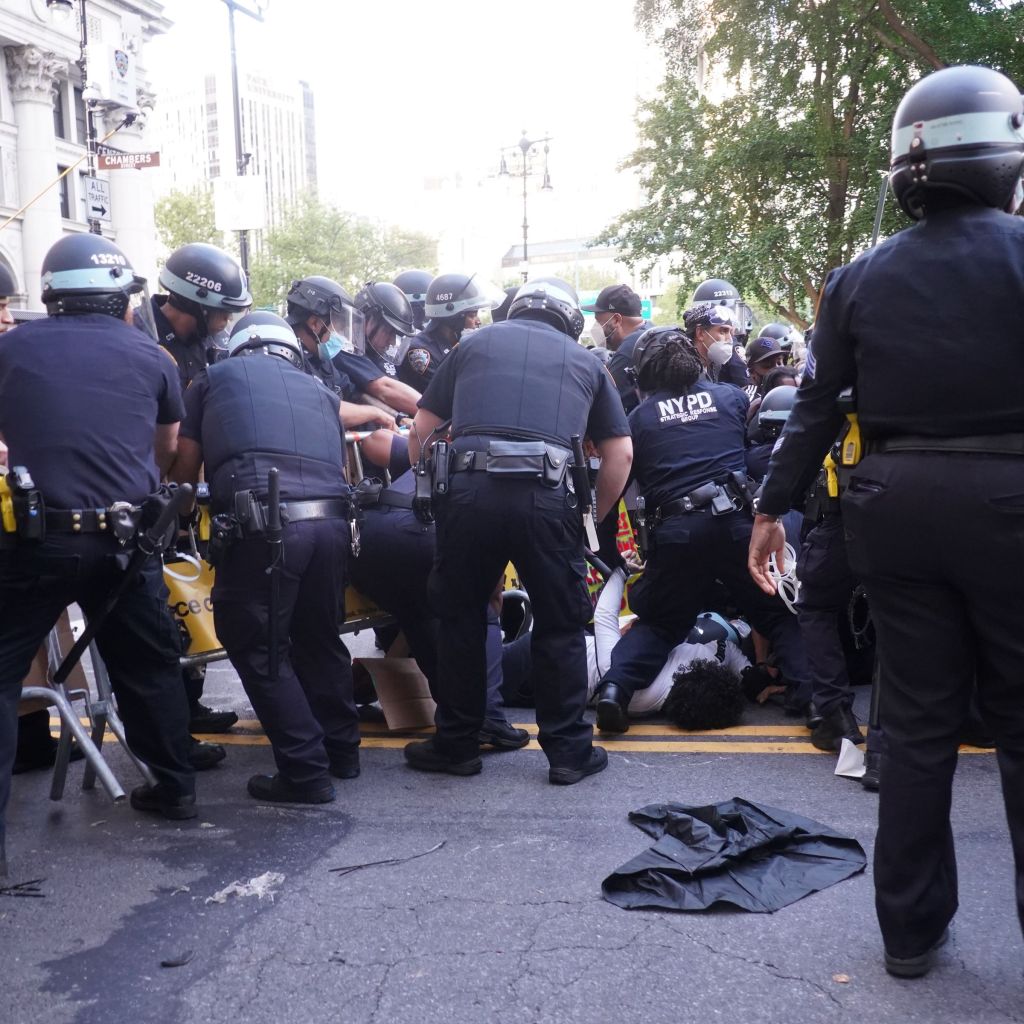
The NYPD reported that two officers suffered minor injuries during the protest, which was attended by about 100 marchers; officials could not immediately say how the cops were hurt.
At least some of those arrested were accused of attacking Daily News photographer Sam Costanza at the intersection of Sixth Avenue and 54th Street in the mistaken belief that he was a cop, sources said.
The photog was surrounded and struck after one of the marchers recognized him from a BLM protest outside the NYPD’s 6th Precinct house in Greenwich Village last year, according to sources.
The agitated protester began yelling, “He’s a cop,” inciting many of his fellow marchers.
About a dozen people surrounded the photog, shoving him and beating him with their fists and other objects, sources said.
The NYPD confirmed the attack, telling The Post “a member of the media” was assaulted, and police made “a number of arrests.”
BOCA RATON, Fla. — In December 2016, law enforcement agents seized computers and hard drives from the home of Tay Christopher Cooper, a retired high school history teacher, in Carlsbad, California. On the devices, digital forensic experts found more than 11,600 photos and videos depicting child sexual abuse, according to court documents.
Among the videos was one showing a man raping a toddler girl, according to a criminal complaint.
“The audio associated with this video is that of a baby crying,” the complaint states.
Police were led to Cooper’s door by a forensic tool called Child Protection System, which scans file-sharing networks and chatrooms to find computers that are downloading photos and videos depicting the sexual abuse of prepubescent children. The software, developed by the Child Rescue Coalition, a Florida-based nonprofit, can help establish the probable cause needed to get a search warrant.
Cooper had used one of the file-sharing programs monitored by the Child Protection System to search for more than 200 terms linked to child sexual abuse, according to the complaint.
Cooper was arrested in April 2018 and pleaded guilty to possession of child pornography. He expressed remorse, according to his attorney, and in December 2018 he was sentenced to a year behind bars.
Cooper is one of more than 12,000 people arrested in cases flagged by the Child Protection System software over the past 10 years, according to the Child Rescue Coalition.
The tool, which was shown to NBC News earlier this year, is designed to help police triage child pornography cases so they can focus on the most persistent offenders at a time when they are inundated with reports. It offers a way to quickly crack down on an illegal industry that has proved resilient against years of efforts to stop the flow of illegal images and videos. The problem has intensified since the coronavirus lockdown, law enforcement officials say, as people spend more time online viewing and distributing illegal material.
The Child Protection System, which lets officers search by country, state, city or county, displays a ranked list of the internet addresses downloading the most problematic files. The tool looks for images that have been reported to or seized by police and categorized as depicting children under age 12.
The Child Protection System “has had a bigger effect for us than any tool anyone has ever created. It’s been huge,” said Dennis Nicewander, assistant state attorney in Broward County, Florida, who has used the software to prosecute about 200 cases over the last decade. “They have made it so automated and simple that the guys are just sitting there waiting to be arrested.”
The Child Rescue Coalition gives its technology for free to law enforcement agencies, and it is used by about 8,500 investigators in all 50 states. It’s used in 95 other countries, including Canada, the U.K. and Brazil. Since 2010, the nonprofit has trained about 12,000 law enforcement investigators globally.
Still, it’s a drop in the ocean of online child sexual abuse material in circulation. In 2019 alone, the National Center for Missing and Exploited Children received 16.9 million reports related to suspected child sexual exploitation material online.
Now, the Child Rescue Coalition is seeking partnerships with consumer-focused online platforms, including Facebook, school districts and a babysitter booking site, to determine whether people who are downloading illegal images are also trying to make contact with or work with minors.
“Many of these platforms have a big problem of users engaging in suspicious activity that doesn’t rise to criminal behavior,” said Carly Yoost, CEO of the Child Rescue Coalition. “If they matched their user data with ours, it could alert their security teams to take a closer look at some of their users.”
But some civil liberties experts have raised concerns about the mass surveillance enabled by the technology — even before it’s connected with social platforms. They say tools like the Child Protection System should be subject to more independent oversight and testing.
“There’s a danger that the visceral awfulness of the child abuse blinds us to the civil liberties concerns,” said Sarah St.Vincent, a lawyer who specializes in digital rights. “Tools like this hand a great deal of power and discretion to the government. There need to be really strong checks and safeguards.”
Rohnie Williams had waited 30 years for the news she received in November 2015: Her brother, Marshall Lugo, had been arrested on charges of possession of child pornography.
“It was exhilarating in a ‘Twilight Zone’ way,” said Williams, 41, a New York-based nurse manager. “Your heart starts palpitating. Your mouth gets dry. You feel like you are going to get justice.”
Williams got in touch with Megan Brooks, the investigator on the case in Will County, Illinois, and told her that Lugo, then a teenager, had sexually abused her from the ages of 5 to 7 — allegations that are documented in a police report reviewed by NBC News.
Williams had told her mother about her allegations when she was 11 on the way to a doctor’s visit after she got her first period.
“I was afraid the doctor was going to tell her I wasn’t a virgin. So I told her that,” she said.
Rohnie Williams as a young child.Courtesy of Rohnie Williams
Her mother didn’t report the allegation to the police and, according to Williams, told her daughter that if she told anybody else it would destroy the family. So Williams, like so many victims of child sexual abuse, kept quiet. (Williams’ mother confirmed her daughter’s account to NBC News.)
Police were led to Lugo’s mobile home by the Child Rescue Coalition’s technology, which detected the household IP address’ downloading dozens of videos and images depicting the abuse and rape of babies and children under age 12. When police searched the home, where Lugo lived with his wife and two young children, they found external hard drives storing child sexual abuse material, according to the police report.
Although too much time had passed to investigate Williams’ allegation as a separate crime, her testimony provided aggravating circumstances in Lugo’s sentencing to three years in prison following a guilty plea, according to Brooks, chief investigator for the Will County High Technology Crimes Unit, who led the case.
“Some days I feel like crap doing this job, but sometimes I have full-circle moments where it all feels worth it,” Brooks said. “This was one of those cases.”
While Williams has thrived professionally, she has struggled to forgive her brother. She spends her weekends working as a sexual assault nurse examiner, providing specialist care and forensic exams to rape victims.
“I chose to go into forensics because of what happened to me as a child, to make sure these victims had somebody taking care of them who was really invested in it,” she said.
Tokyo’s coronavirus numbers continue to fall; US military in Japan, South Korea reports 23 new cases
Travelers wear masks inside a departure terminal at Narita International Airport east of Tokyo, Jan. 15, 2021.
TOKYO – The number of one-day coronavirus infections in Tokyo dropped to its lowest figure in more than a month Monday, although the government is likely to extend a state of emergency there and in Osaka, public broadcaster NHK reported.
U.S. military installations in Japan reported nine individuals infected between Friday evening and 6:30 p.m. Monday, all but two of them at Marine Corps bases on Okinawa. Meanwhile, U.S. Forces Korea announced 14 new cases, mostly new arrivals to the peninsula over the previous two weeks.
The Tokyo Metropolitan Government announced 393 new infections Monday, according to NHK. That’s the lowest figure since Dec. 21, also a Monday, when the city reported 392 new cases. The daily count had stood above 500 since Dec. 29.
Monday figures are typically low because many testing facilities in the city are closed over the weekend.
NHK reported that the national government on Monday agreed to consult with its panel of experts on extending the state of emergency that expires Thursday in the Tokyo and Osaka areas. The government declared the emergency in Tokyo and three surrounding prefectures Jan. 8 and in seven more prefectures a week later.
Under the emergency, businesses are asked to close earlier, workers to telework and residents to avoid travel outside the area. The measures are largely voluntary.
Though new case numbers are falling in Tokyo, medical facilities are still strained and the proportion of elderly residents at risk is increasing, according to NHK.
About 26 miles southwest of Tokyo, Naval Air Facility Atsugi reported one new coronavirus case Monday, an individual already in quarantine after contact with another infected person, base spokesman Sam Samuelson told Stars and Stripes by phone. The base is monitoring 12 patients.
Sasebo Naval Base on Kyushu island had one person test positive on Saturday, according to a Facebook post. The individual, who recently arrived in Japan, came up positive on the test required to exit quarantine. The base is monitoring three patients.
On Okinawa, the Marines between Friday evening and Sunday reported seven individuals had tested positive: two at Camp Hansen on Sunday; two at Camp Foster and one at Hansen on Saturday; and one at Hansen and one at Camp Kinser on Friday, according to official Facebook posts.
South Korea on Sunday reported 285 newly infected individuals, 104 of them in Seoul and 89 in Gyeonggi province, home to Camp Humphreys, the largest U.S. base in the country.
USFK said a “Department of Defense dependent” who lives in Seoul and has access to Yongsan Garrison tested positive Friday before exiting quarantine, according to a Monday news release. The individual remains in isolation at Humphreys.
USFK said another 13 people arriving in South Korea tested positive for COVID-19, the coronavirus respiratory disease, between Jan. 15 and Friday, according to another release Monday.
One service member and a dependent arrived Wednesday at Osan Air Base aboard the Patriot Express, a government-chartered air passenger service. Ten service members and one civilian arrived at Incheon International Airport aboard commercial flights on Jan. 15, 19, 24, 26, Thursday and Friday.
Nine tested positive on their first mandatory test before entering quarantine; four tested positive on the mandatory test to exit quarantine. All are in isolation at either Humphreys or Osan.
Also Monday, USFK commander Gen. Robert Abrams extended the military’s public health emergency until April 27, which permits installation commanders to continue enforcing restrictions aimed at curbing the virus’ spread.
The U.S. military in South Korea has reported 675 coronavirus cases during the pandemic, only 76 of whom were infected locally.
A Philadelphia sex offender has been arrested after police pulled over the U-Haul in which he was a passenger and found part of a body in the back, which would lead them to discover deep-fried body parts in a nearby dumpster, The Philadelphia Inquirer reports. Taray Herring, 47, was cuffed.
Taray Herring, 47, was cuffed after he got out of the U-Haul. Once the cops had discovered the deep-fried body parts, he was charged with criminal trespass, theft and tampering with evidence.
Herring is being held without bail while the police continue to investigate this bizarre case involving a U-Haul on the run and the deep-fried body parts.
The following morning, Philadelphia cops were called back to the same home due to an apparent robbery.
The police trailed a U-Haul truck they saw driving away from Gerold’s home and pulled it over. The driver burst out of the vehicle and said, “I don’t want anything to do with this, and there’s a body in the back.” Indeed, the police found the dismembered corpse, and would soon after find the apparently matching deep-fried body parts.
The landmark legislation was designed to crack down on the “appalling crime” – which ranges from forced prostitution to labour exploitation and domestic servitude – with simplifed offences and tougher punishments.
But a JPIMedia investigation has exposed the extent to which perpetrators are escaping justice, with just 4.2% of modern slavery offences recorded by English and Welsh police forces between 2015 and September 2020 resulting in a charge.
In Scotland, 68 out of 475 (14%) human trafficking crimes recorded since the 2015 Human Trafficking (Scotland) Act saw enough evidence gathered for charges to be brought.
The Human Trafficking Foundation, which brings together charities, public bodies and parliamentarians working to tackle slavery, has now said “radical” change is needed to how UK authorities pursue offenders and support victims.
Home Office figures show police forces in England and Wales have recorded 19,547 offences under the Modern Slavery Act to date. But just 828 of these saw a suspect charged.
The proportion of cases resulting in a charge has fallen every year since 2015 as the volume of offences has increased.
For the small proportion of cases that make it to court, analysis of Ministry of Justice figures shows just 21.5% end in a conviction, with only 74 successful cases out of 344 court proceedings in England and Wales between 2015 and 2019 where modern slavery was the principal offence.
In Scotland, just nine cases have gone before the courts in the last five years, with three more ongoing. The Scottish Government reports just one confirmed conviction, plus two more where human trafficking was not the main charge, as of 2018/19.
And while police in Northern Ireland failed to respond to a freedom of information request, requests to the Department of Justice show there have been between 19 and 21 human trafficking prosecutions as of September, and between seven and 10 convictions.
Tamara Barnett, director of the Human Trafficking Foundation, said modern slavery cases were often “very, very difficult” to investigate and that a lack of wider support for victims means they are often distrustful of and unwilling to work with police.
But while the Home Office figures show police in England and Wales most commonly cite failure to identify a suspect and victims not supporting action as reasons for not bringing charges (8,350 and 6,646 cases respectively since 2015) there have also been 2,677 cases where a suspect was identified and the victim was on board.
Ms Barnett added that “there are definitely better police forces unfortunately” which she put down to a lack of leadership in some constabularies.
While the figures show one police force has never brought a single charge (Gwent) and three have a charge rate of less than 1% (Sussex, Thames Valley and Hertfordshire), Lancashire Constabulary tops the board with a charge rate of 28.9%.
Ms Barnett said: “There is often a lot of ignorance we find, particularly in certain rural areas, they think they don’t have human trafficking.
“It’s a bit like with drug problems, if you don’t lift the lid, you don’t have a drug problem. You have to look for it to find it. It’s not something that pops up openly. A lot of forces don’t want to go down that direction – or don’t even recognise it as a crime.”
Radical change, including amending the 2015 Act to lower the theshold of what constitutes modern slavery and better recognise non-violent means of coercion, is needed to improve things, she added.
Independent Anti-Slavery Commissioner Dame Sara Thornton – a role created by the 2015 Act – said the current lack of risk to criminals “fails to counter the economic reward of trafficking in people, or prevent organised crime groups acting with impunity”.
She called on police to “take advantage of the full spectrum of evidential opportunities to reduce reliance” on victims’ testimony, adding prosecutions should be “victim focused but not victim reliant”.







 realfree.news.blog